After Tocqueville: Pittsburgh, Altoona, and the American Ascendancy
November 5–9, 2026
2026-11-09 (prior)
In late November 1831, a young French magistrate named Alexis de Tocqueville crossed the Allegheny Mountains by stagecoach in the first hard snow of the winter, came down into Pittsburgh, and a few days later boarded a steamboat improbably named the Fourth of July for the trip down the Ohio. He had come to America to study its prisons and stayed to study its democracy, and the book he wrote from those nine months, Democracy in America, remains the most famous portrait of a nation in its ascendancy: restless, inventive, self-organizing, and certain of its future.
Nearly two centuries later, in the same month of the year, I came to the same city for the Burn After Meeting conference, held over a weekend at the Wyndham Grand at the Point, and built the surrounding days into a small expedition: vintage vinyl, vintage computers, a railroad pilgrimage across the same mountains to Altoona, and what remains of the steel industry at Homestead. I made the trip without a car in Pittsburgh, relying on rideshares, Amtrak, and a single day’s rental in Altoona.
Without intending it, I found myself taking an inventory of what Tocqueville’s America went on to build in this corner of Pennsylvania, and of how much of it now stands empty, rusting, or behind a shopping center. What follows is an account of the trip as it happened, read against his, with practical notes for whoever follows.
Written during the trip from notes sent along the way, with background research added and the sources collected in the notes at the end.
A Note on Tocqueville
Alexis de Tocqueville (1805–1859) and his friend Gustave de Beaumont traveled through the United States from May 1831 to February 1832, nominally on a commission from the French government to study American penitentiaries. Their route took them from New York to the Michigan frontier, through New England and Philadelphia, over the Alleghenies to Pittsburgh in late November, and down the Ohio and the Mississippi to New Orleans. The steamboat that carried them out of Pittsburgh struck a reef near Wheeling and sank; all aboard survived. In a letter written aboard it, Tocqueville noted that Pittsburgh stood on the site of the old French Fort Duquesne and admired how shrewdly the French had placed it.1
The two volumes of Democracy in America, published in 1835 and 1840, argued that equality of conditions was the defining fact of American life, and traced its consequences: a passion for practical improvement over abstract theory, an extraordinary habit of forming voluntary associations, a relentless commercialization drive, and, he warned, a few dangers that democracy would have to watch for. Several of those observations turned out to describe, with uncanny precision, the places I visited.
Thursday: Into the City
Tocqueville was struck above all by how Americans organized themselves. “Americans of all ages, all conditions, and all dispositions constantly form associations,” he wrote, for every purpose from building churches to founding schools. Thursday took me through a city whose industry has moved away and a town that lost its reason for being, and ended among a band of volunteers keeping a museum running for no reason but that they care. The associations, at least, are still here.
Through the Fort Pitt Tunnel
The ride in from the airport delivered the first surprise of the trip. The highway runs through the Fort Pitt Tunnel under Mount Washington. One enters surrounded by ordinary wooded hills and emerges, without warning, onto the Fort Pitt Bridge with downtown Pittsburgh, the Point, and the rivers filling the windshield. It is a genuinely dramatic entrance, and its reputation is deserved: the view has been called the best way to enter an American city.
The tunnel is 3,614 feet long. Work began in 1957, and it opened on September 1, 1960, as the last link in the Penn Lincoln Parkway. The bridge it opens onto had been finished some fifteen months earlier.2
Jerry’s Records
I went straight from the airport to Jerry’s Records on Murray Avenue in Squirrel Hill, bags in tow. The entrance is a narrow doorway on the street with a flight of stairs leading up to the shop. Upstairs, the selection is excellent, room after room of used vinyl, and I left with seven albums from my want list.
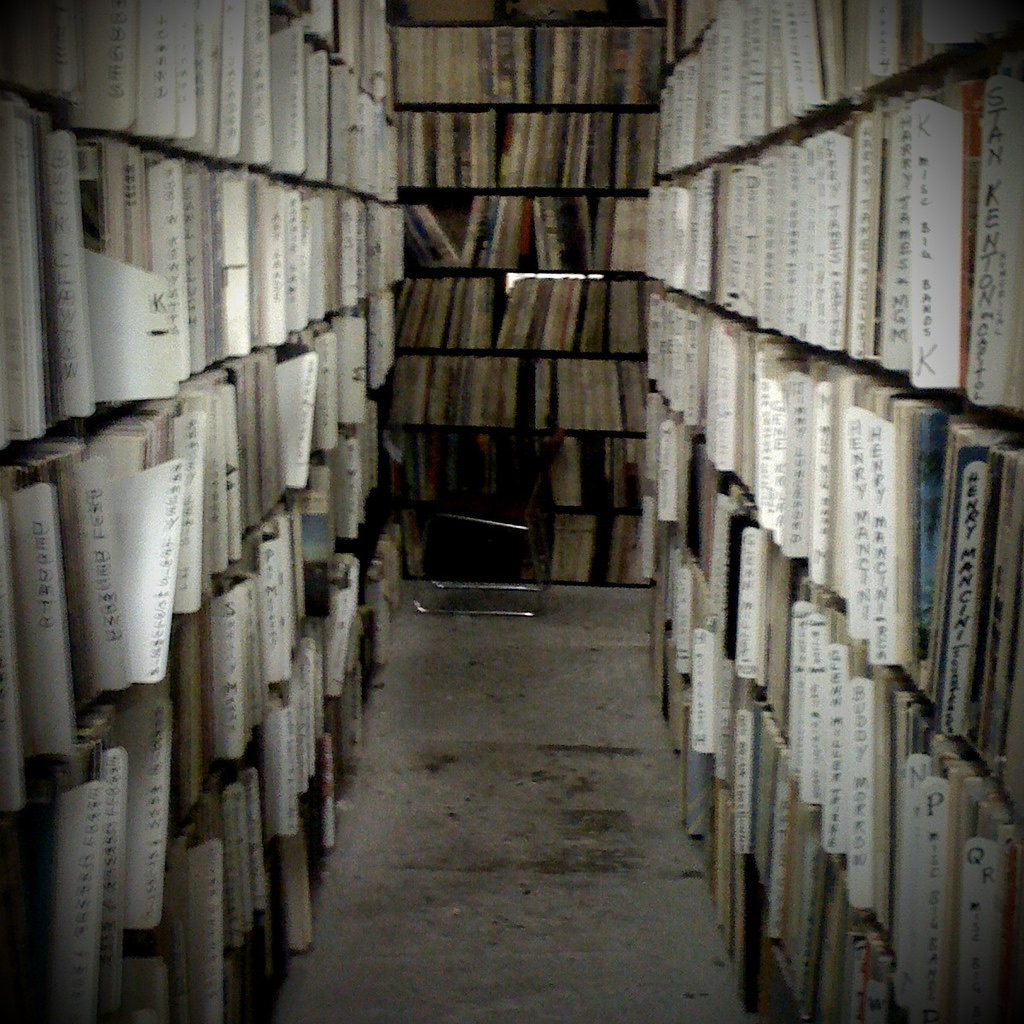
The service was less impressive. The staff seemed rushed when I asked where to find things, so a visitor does well to arrive with a want list already organized by the store’s typical bin categories. The shop also prefers cash. Paying by card adds a significant service fee, though there is an ATM on site.
The haul from Jerry’s:
| Artist | Album | Catalog number | Year | Notes | Price |
|---|---|---|---|---|---|
| The Dave Brubeck Quartet | Time Out | PC 8192 | 1970s | Later Columbia reissue (“PC” on the spine); Jerry’s sleeve reads “Nice 70s press” | $7 |
| Jethro Tull | Aqualung | MS 2035 | 1971 | US first pressing: tan Reprise “steamboat” label | $7 |
| Paul McCartney | Ram | SMAS-3375 | 1971 | $7 | |
| Pink Floyd | The Dark Side of the Moon | SMAS-11163 | 1973 | 1970s US Winchester pressing, complete with both posters and stickers; runout SMAS-1-11163-F30 #2 ─◁, “MASTERED BY CAPITOL” on both sides, no “Wly” | $60 |
| Boston | Boston | JE 34188 | 1976 | Still in the original seal wrap; no barcode, so likely a 1970s pressing | $45 |
| Tom Petty and the Heartbreakers | Damn the Torpedoes | MCA-5105 | 1979 | “MCA-1486” in gold foil at the top right of the cover | $20 |
| The Cars | The Cars | 6E-135 | 1978 | “6E-135-A6” scratched in the inner runout | $20 |
The list prices came to $166. I paid a generously rounded $170 for all seven, including tax.3
Checking In
From Jerry’s I took an Uber to the Wyndham Grand Pittsburgh Downtown at 600 Commonwealth Place, the conference hotel, which sits at the Point beside Point State Park. I checked in mid-afternoon and pre-booked my return ride before setting out for New Kensington.
New Kensington and Its Reputation
My driver to Jerry’s warned that getting to New Kensington would be easy but getting back might not be, and that the town has a rough reputation.
New Kensington was, in effect, the city Alcoa built. For most of the twentieth century it was home to one of Alcoa’s largest production plants, which employed about a fifth of the city’s residents. After the Second World War the plants were aging, Alcoa built newer ones elsewhere, and in 1970 it announced the closure of the New Kensington Works. With it went the town’s principal employer, much of its tax base, and much of its population.
The town also carries an older shadow in that from the 1940s through the 1960s it had a well-known organized-crime presence under the Mannarino brothers, a crew of the Pittsburgh crime family and earned the nickname “Little Chicago.” One doctoral history of the town is titled Birthplace of Aluminum, Cradle of Crime. The economic strain persists: census figures put the poverty rate near 23 percent and median household income around $43,000. Empty storefronts set the first impression. The scarcity of rides follows naturally, since few passengers need a trip back to Pittsburgh and drivers risk a long empty return.
But there are signs of a hopeful comeback. Former Alcoa sites are being redeveloped, including the old Alcoa Research Laboratory, now a research park, and a museum of vintage computers on 4th Avenue is part of that newer story. In my reading, the warnings reflect a struggling downtown and thin services rather than any real risk to a visitor at a museum in the late afternoon.4
The Large Scale Systems Museum
The reason for the trip to New Kensington was the Large Scale Systems Museum, and it was amazing. Behind an ordinary storefront at 924 4th Avenue, in a former department store, a volunteer organization has assembled two floors of computing history. The first floor concentrates on the big iron: mainframes, minicomputers, and supercomputers from the 1970s through the 1990s, from IBM, DEC, Cray, and less familiar makers. Upstairs is a large collection of microcomputers from the 1970s and 1980s. What sets it apart is that most of these machines are not static exhibits. They work.
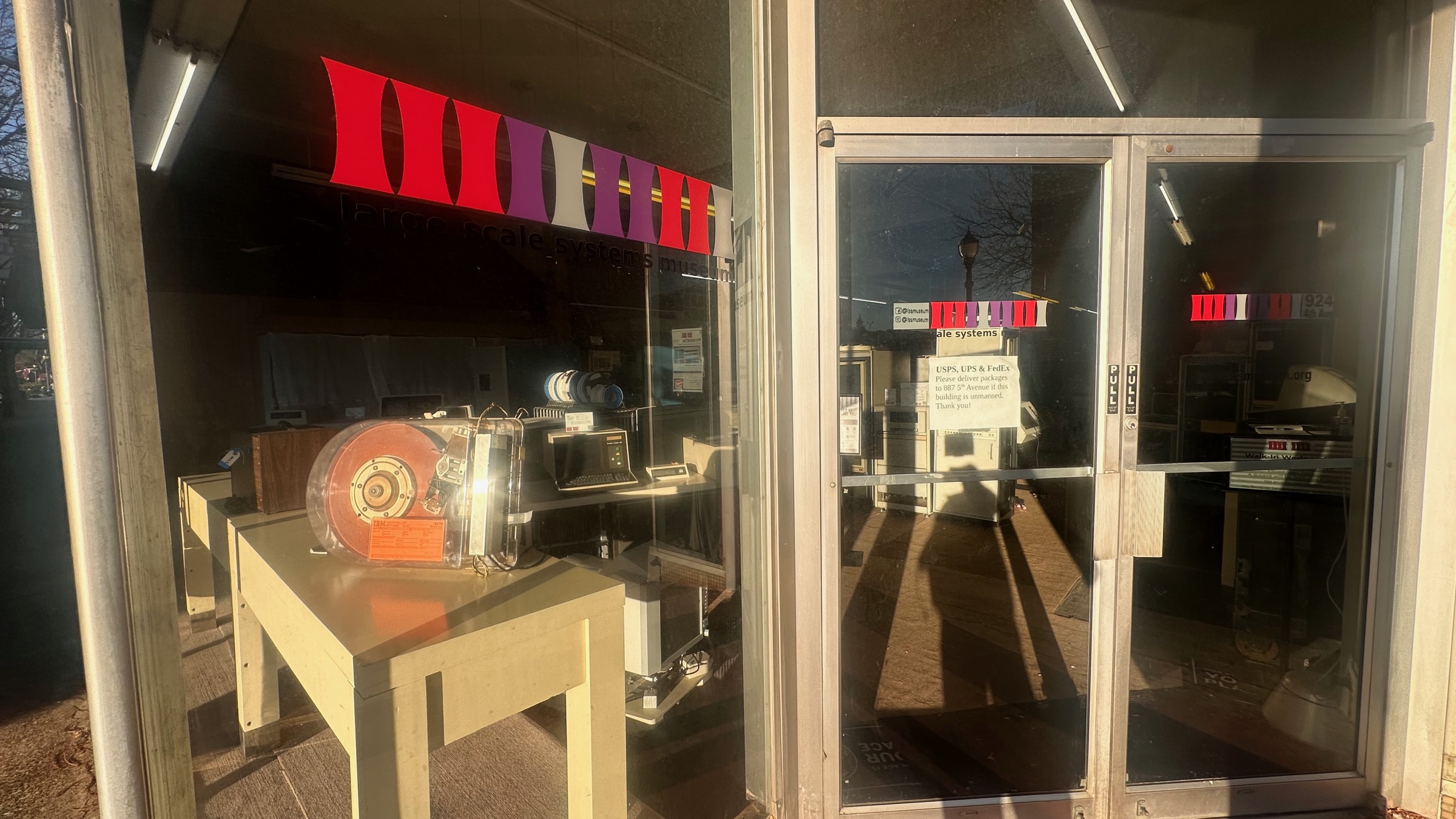
I have also visited the Computer Museum of America in Roswell, Georgia, and the two make an interesting comparison. The Georgia museum has the deeper selection of Cray supercomputing. The Large Scale Systems Museum has a much broader and more eclectic collection overall, including some real gems. Mark Dalrymple, one of the volunteers, gave me an excellent private tour. He booted several of the systems for me and shared a wealth of information about each. For someone who has spent forty years in this field, seeing these machines running again, and hearing about them from someone who keeps them running, was a genuine pleasure.
The museum has no regular public hours. The volunteers all have day jobs, so visits are by appointment, and afternoons are easiest for them. Admission is free, and donations are appreciated. I would highly recommend it to anyone with an interest in computing, and I intend to return.
Highlights of the Collection
The museum holds very nearly one example of every key machine in the early microcomputer evolution, but these were the pieces that stayed with me:5
- IBM System/32 (1975). A small-business computer built into what looks like an office desk. Its display is a marvel of improvisation: a cathode ray tube mounted vertically inside the desk, viewed through a 45-degree mirror in a small housing on the console. The screen shows just six lines of forty characters.
- DECSYSTEM-2020 from the MIT AI Lab. A note on the machine says it came from MIT’s Artificial Intelligence Laboratory. For me this one is personal. Richard Greenblatt, one of the legendary AI Lab hackers, was the friend of Steve Grant, father of my own friend, Darin Grant, in Columbia, Missouri. Greenblatt was the principal implementer of the Lisp that became Maclisp, and he later co-designed the MIT Lisp Machine. I wondered whether this was the machine he wrote his Lisp on. The timeline says probably not: that work began in the mid-1960s on the lab’s PDP-6, and the 2020 was a later, smaller member of the same 36-bit PDP-10 family, introduced in the late 1970s. But it ran the same architecture his Lisp was built for, and it came from the same lab.
- Intel iPSC “Personal Supercomputer” (1985). One of the first commercial parallel computers built from off-the-shelf parts: a cabinet of processor cards wired together as a hypercube. Published specifications give each node an Intel 80286 with an 80287 math coprocessor, the same chips as the IBM PC/AT.
- Okidata Microline 92 printer. The workhorse I used all through college with my Apple \e. Seeing one again was like meeting an old friend.
- Heathkit EC-1 analog computer (about 1960). A vacuum-tube educational analog computer with nine operational amplifiers, “programmed” with patch cords. It solves differential equations by modeling them as voltages, and it was one of the first analog computers almost anyone could afford.
- Symbolics XL1201 Lisp machine. A descendant of the MIT Lisp Machine Greenblatt co-designed, shown with the famous “space cadet” style keyboard and its baroque array of modifier keys.
- Tektronix 4081 graphics system (1977). A 19-inch direct-view storage tube driven by an Interdata minicomputer, and a genuine piece of Battlestar Galactica history. Tektronix supplied several hundred instruments to the original 1978 series, including ten 4051 graphics computers that appear throughout the bridge set. The 4081 played a double role. Behind the scenes, Tektronix engineers used it to generate the vector-graphics battle displays of Cylon attacks. On the set, Tektronix’s own customer magazine, Tekniques, reported in 1978 that the 4081 was cast as the ship’s real-time fighter-target and enemy-identification display and as the commander’s personal console, with hard-copy units recording its output. Mark pointed out that its keyboard can be seen in at least one scene. Not every account agrees: one Tektronix engineer later recalled the 4081 being used only off-set, so the on-camera role may have been brief. Either way, this model of machine helped put the Cylons on screen.6
- Parsytec SuperCluster. A German transputer-based parallel computer from the late 1980s whose processor network could be rewired in software, through network configuration units, to suit the problem being solved.
- Apple Lisa with “Twiggy” disks. The original Lisa used Apple’s own FileWare 5¼-inch double-sided floppy drives, nicknamed “Twiggy.” They proved unreliable, and in 1984 the Lisa 2 replaced them with the Sony 3½-inch drive the Macintosh adopted. Twiggy disks were never used in any other computer and are scarce today.
The Ride Back
The pre-booked return ride turned out to be one of the best parts of the day. My driver has driven twelve-hour days for Uber for eleven years, and he goes out of his way to serve New Kensington. He sees it as his part in helping the town recover and in improving its reputation, one passenger at a time.
He has no patience for fast food on those long shifts. Instead, he buys fresh submarine sandwiches ten at a time from a local New Kensington shop and keeps them with him in the car. Partway back to Pittsburgh, he handed me one: a full-length pepperoni and cheese sub. It was excellent. I regret not catching the name of the shop because it deserves the mention.
After an afternoon of hearing about the town’s rough reputation, it was a fitting counterpoint. The warnings were about where the town has been. The driver and his sandwich were about where it is going.
For the next visitor
- Fort Pitt Tunnel: Have a camera ready before you enter. The view comes only inbound and lasts only as long as it takes to cross the bridge.
- Jerry’s Records: 2136 Murray Ave. Look for the narrow street doorway. Bring cash and an organized want list.7
- New Kensington: Pre-book your return ride or arrange for your outbound driver to come back for you. The museum volunteers can also suggest a local cab.
- Large Scale Systems Museum: 924 4th Ave, New Kensington. Visits by appointment only; email info@lssmuseum.org a few days ahead and ask for an afternoon slot. Free, with donations appreciated. A guided tour is essential, since many machines have little signage. Highly recommended for first-time and repeat visitors.
- Primanti Bros., Market Square: Recommended by my second Uber driver. Pittsburgh’s signature sandwich, served since 1933: grilled meat, provolone, tomato, oil-and-vinegar coleslaw, and fresh-cut fries piled inside thick Italian bread rather than served on the side. The Market Square location (2 Market Square) is a short walk from the Wyndham Grand. The original is in the Strip District. I finally had one on Sunday; it is excellent, but come hungry, because I could finish only half.8
Friday: Altoona by Rail
When Tocqueville crossed these mountains in 1831, the stage road was a misery, and Pennsylvania was in the middle of building its answer: the Main Line of Public Works, a chain of canals joined over the Alleghenies by the inclined planes of the Allegheny Portage Railroad, which opened three years after he passed. He found in Americans people who preferred useful science to theory and could not stop improving their roads and waterways. The Pennsylvania Railroad, which swept the canal and the portage aside within a generation, was that spirit at its height. Friday was a day spent among its works and among what has become of them.
The Morning Walk
Rather than take an Uber, I walked the mile from the hotel to Union Station before dawn, cutting over to Liberty Avenue. Despite the street’s reputation, the route felt safe, and several pleasant public art installations along the way made the walk worthwhile in the dark.
Partway along I stopped at The Coffee Village, 801 Liberty Avenue, which opens at 6 AM. The selection was limited and unremarkable, but the price was reasonable, and its location makes it a perfectly placed break on the walk to the station.
Union Station
The station area is a wreck. The grand 1903 Burnham building with its rotunda still stands, but its interior is now apartments, and Amtrak passengers are relegated to a cramped annex behind it. 9 It is unacceptable how far we have let passenger rail in America decline. For a nation which calls itself the greatest, it is a global embarrassment, and a sign, to my mind, that we are past our ascendancy and on the wane. Tocqueville, crossing these same mountains by stagecoach, saw people who could not stop building roads, canals, and railways; I wonder what he would make of a great passenger station reduced to an annex.
The Pennsylvanian was expected to be completely sold out, with more passengers boarding at stops along the way. I upgraded to Business Class, and so far its car is only sparsely occupied: a comfortable way to ride toward the Horseshoe Curve.
The conductor’s announcements were a pleasure in their own right, delivered with good humor, much like the old-school Southwest Airlines cabin crews before that airline grew stuffy. It set a friendly tone for the ride east through Greensburg, Latrobe, and Johnstown.
The restrooms are a pleasant surprise compared with an airliner’s: far roomier and apparently built with accessibility in mind. The one drawback is the unmistakable smell of portable-toilet chemical.
The ride itself was smooth, uneventful, and on time. The highlight came shortly before Altoona, when the train swung around the Horseshoe Curve. From my seat on the right side, the view across the curve was awesome, well worth choosing the seat for.
Enterprise met me at the station as promised, and the pickup went smoothly. Driving out toward the Curve, I was struck by Altoona’s beautiful historic houses, a legacy of the years when the Pennsylvania Railroad’s shops made this one of the busiest railroad towns in the country.
Altoona: The Railroad’s City
Altoona did not grow up and then attract a railroad; the railroad created it. In 1849 the Pennsylvania Railroad chose this spot at the eastern foot of the Allegheny Front as the base for its assault on the mountains and laid out a town around its shops. The challenge was formidable: the Alleghenies stood between Philadelphia and Pittsburgh, and before the railroad the only through route was the slow Main Line of Public Works, with its canals and the inclined planes of the Allegheny Portage Railroad. The Pennsylvania’s engineers, led by J. Edgar Thomson, answered with a steady climb up the mountainside, and in 1854 they opened the Horseshoe Curve, which bends the line around a valley to gain height at a grade locomotives could manage. Trains could now run all the way across the state, and Altoona became the place where they were built, maintained, and helped over the mountain.
Over the following decades Altoona grew into one of the great railroad towns of the world. The Pennsylvania concentrated its heavy industry here: the Altoona Machine Shops, the Juniata Shops, and a sprawl of car shops, foundries, and yards that together formed one of the largest railroad shop complexes anywhere. At their peak in the early twentieth century, the shops employed well over ten thousand people, and the town’s life ran on the shop whistle. Altoona was not only a place for repairs. The railroad designed and built thousands of its own locomotives here, among them the famous K4s passenger engines, and it ran a locomotive testing plant and laboratories that made the city a center of railroad engineering. The handsome houses along its streets, from workers’ rows to the homes of managers and master mechanics, are the visible legacy of that prosperity.
The railroad’s importance made Altoona a target. In 1942 German saboteurs landed on the American coast under Operation Pastorius with orders that included the Horseshoe Curve and the Altoona shops. The plot collapsed when two of the agents turned themselves in, but it shows how central this stretch of track was to the nation’s war effort.
The decline came with the long fall of American railroading after the Second World War. Diesels needed far less maintenance than steam, traffic shifted to highways and airlines, and the Pennsylvania merged into Penn Central in 1968 before going bankrupt. Employment in the shops fell steadily. Yet the railroad never left entirely: the Juniata Shops still repair and rebuild locomotives for Norfolk Southern, and the Curve remains a busy main line, with freight trains rounding it day and night. The Railroaders Memorial Museum, housed in the railroad’s old Master Mechanics Building downtown, tells the story of the people who built and ran it all.
My driver from the station put it simply: the shops closed when the railroad was bought out. The fuller story is a long series of contractions rather than one closing. Conrail, which took over the bankrupt Penn Central in 1976, cut back the Altoona operations, and when Norfolk Southern and CSX divided Conrail in 1999, Norfolk Southern inherited Altoona and closed or consolidated more of the old shops. The Juniata Locomotive Shop survived, and today it is Norfolk Southern’s principal locomotive repair and rebuilding shop, so locomotives are still being worked on in Altoona more than 170 years after the first shops opened.
Figures in this section are drawn from general histories of the Altoona shops, chiefly the National Park Service’s history listed in the notes at the end.10
The Horseshoe Curve, Up Close
The museum operators never returned my call about whether the Curve was still open for the season, so I simply chanced it. Luckily for me, it was open. The visitor center’s small museum tells the story of the Curve’s construction, but the funicular that normally carries visitors up the hillside was closed, which meant a long climb up the stairway to the trackside viewing area at the top: 194 steps, winding up the hillside past 20 landings, roughly ten stories in all. It is a real climb, but the landings break it up, and it is entirely manageable at an unhurried pace. The gift shop sells a combination ticket that also covers the Railroaders Memorial Museum in downtown Altoona.11
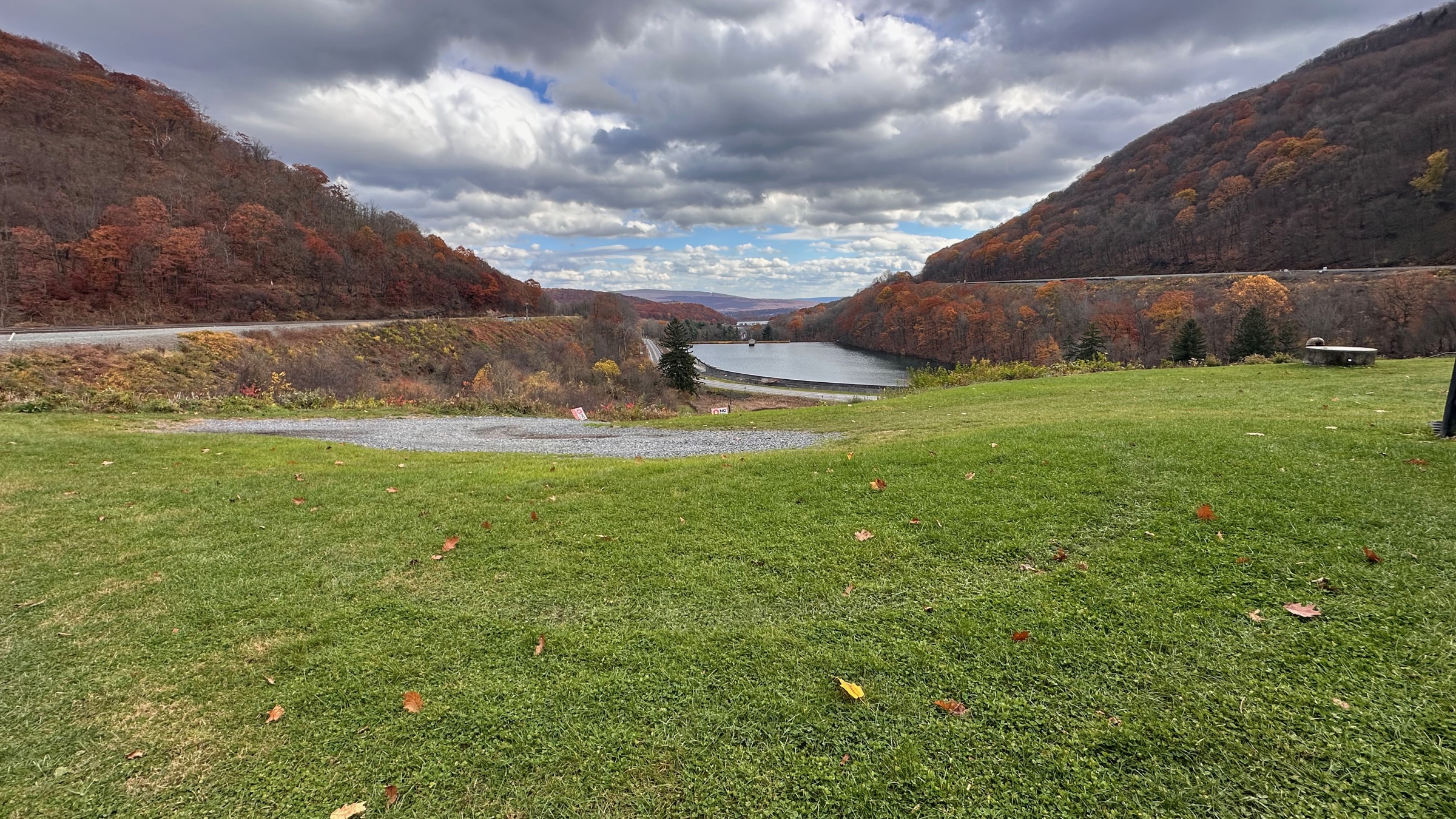
The Curve itself was amazing. Watching from the top, I saw a freight train so long that it ran with locomotives at the head, in the middle, and at the rear. The railroads call these “distributed power” units, and they are now required on the longest, heaviest trains to control the pushing and pulling forces within them. It is a striking sight on a curve engineered in the 1850s, long before anyone imagined trains of this length.
A retired railroader filming at the top told me derailments here now come every few weeks, which he blamed on the sheer length of today’s trains along with smaller crews and reduced maintenance. The record bears out his concern, if not quite his frequency: in 2026 alone, there have been three derailments at or near the Curve, in February (about 65 cars, from a train of 224), March (two locomotives and 17 cars), and August (12 cars). Federal regulators issued a safety advisory on long-train makeup in 2023, and Norfolk Southern has since tightened its rules for how such trains are assembled.12
Gallitzin Tunnels and the Allegheny Portage Railroad
From the Curve I drove up to Gallitzin, at the summit, where the main line passes through tunnels bored beneath the crest of the Alleghenies. The small Gallitzin Tunnels museum had already closed for the season, but the grounds remain open, with a viewing area overlooking the tunnel portals. Despite a line that sees dozens of trains a day, none came through in the forty-five minutes I waited, so I moved on. Railfanning rewards patience, but not always.
The Allegheny Portage Railroad National Historic Site, a few miles on, turned out to be a highlight. It tells the story from before the Horseshoe Curve: how, in the 1830s, canal boats and their cargo were hauled over the mountains on a series of inclined planes powered by stationary steam engines. It gave me a different and very welcome perspective on the region’s railroad history, showing just how hard the mountains were to cross before the Pennsylvania Railroad’s engineers solved the problem with the Curve.
The orientation film in the visitor center is a bit cheesy, but it is worth watching for the way it sets the scene.
The Railroaders Memorial Museum
Back in town, I spent the mid-afternoon at the Railroaders Memorial Museum, housed in the Pennsylvania Railroad’s 1882 Master Mechanics Building, on the site of the old 12th Street shops. I saw what I came to see in about an hour, but visitors who want to take in every exhibit or join one of the Saturday roundhouse tours should allow considerably more time.
The museum tells the railroad’s story largely from the public’s side: the people who worked the shops, their neighborhoods, and the city the railroad built. My own interests run more to the inner workings, and on that score the most rewarding material concerned the Pennsylvania’s engineering culture: its systematic, science-based approach to testing, and its practice of designing and building its own locomotives right up to the diesel era. Surprisingly, though, the museum does a poor job of explaining why the railroad did this rather than buying from builders such as Baldwin and Alco. I had to dig into that question separately (see below).
The roundhouse was a disappointment. Most of it was roped off, and the open area was devoted to the restoration of K4s No. 1361, the Juniata-built 1918 Pacific that stood for decades at the Horseshoe Curve. Yet no work appeared to be under way, and there was no good information on the project’s current state. From what I could find afterward, the restoration is real but slow and largely money-bound. Much of the skilled work has moved off site; the six 80-inch driving wheels, for instance, went to the Strasburg Rail Road’s shops for rebuilding. In July 2026 the museum said roughly $2.5 million more is needed to finish the job.13
I was also surprised at how little attention the museum gives to two of the Pennsylvania’s most celebrated designs: the streamlined T1 duplex steam locomotive and the GG1 electric. The museum’s own GG1, No. 4913, built at Juniata in 1942, sits outside by the turntable, visibly rusting, although the museum says it has plans to restore it. Given how long the K4s restoration has taken, I hold out little hope for the GG1.14
What Norfolk Southern has given, on the record. The public record shows Norfolk Southern supporting the museum, though in very modest amounts. In the early 2000s, NS gave $50,000 toward the museum’s Railroad Heritage Scholarship Program for the 2003–2005 school years. Around 2020 it gave $50,000 to the general fund, and in exchange, NS employees get free admission. In 2025 the museum received a share of a $50,000 community grant NS split among three local organizations, and the museum’s share went to marketing outreach. In 2020, NS also donated SD60I No. 2020 to Penn State Altoona’s rail engineering program, and the university later passed it to the museum. I found no record of a direct Norfolk Southern grant to the K4s 1361 restoration. That work has been paid for by individual donors, benefit dinners, a $10,000 Emery Rail Heritage Trust grant, about $7,000 from the NRHS Horseshoe Curve Chapter, and state funds, and a large sum is still to be raised. Norfolk Southern’s strongest tie to the museum is through people rather than the company itself. Retired NS chief executive Wick Moorman chairs the museum board and has arranged matching gifts, and many of the restoration volunteers learned their trade at the NS Juniata shop. For scale, NS reported $6.2 million in community grants across its 22-state network in 2024.15
My own view. It is hard to escape the impression that the Pennsylvania Railroad’s legacy has been sidelined in its own city since Conrail was divided and Norfolk Southern took over Altoona. Preserving this history may not be Norfolk Southern’s job, and the support it has given is real. Still, a few $50,000 gifts over two decades seem to me a token amount from the railroad that inherited the Pennsylvania’s shops, its main line, and much of its heritage. I would like to see some of its considerable profits go directly toward putting 1361 back under steam and the GG1 preserved. Union Pacific has earned much goodwill on their similar efforts.
Why the Pennsylvania Railroad Built Its Own Locomotives
Most American railroads bought their locomotives from commercial builders such as Baldwin, Alco, and Lima, choosing from catalog designs or lightly customized ones. The Pennsylvania Railroad was the great exception. Between 1866 and 1946 its Altoona shops built some 6,800 steam, electric, and diesel locomotives, and Juniata alone turned out about 350 of the 425 K4s Pacifics. The reasons were economic and cultural:
- Scale. At its peak the Pennsylvania was among the largest corporations in the world, with thousands of locomotives. At that size, a full design staff and erecting shops cost relatively little per engine. Smaller roads could never justify the overhead.
- The shops were needed anyway. Altoona and Juniata had to exist for heavy repairs. Building new engines kept a skilled workforce fully employed, kept the builder’s profit in-house, and put quality control in the railroad’s own hands. As early as 1866 the railroad adopted a policy of replacing worn-out engines with new ones rather than performing major repairs, which lowered repair costs per mile.
- Standardization. This was the real payoff. Altoona introduced standard car designs in 1859 and standard locomotive classes in 1868, and by 1900 the system was fully standardized. Classes shared boilers, cylinders, cabs, tenders, and parts, with the distinctive square-shouldered Belpaire firebox across the fleet. Buying from several vendors would have meant several parts inventories and maintenance practices; designing in-house meant one system.
- Testing and science. The Pennsylvania created the first railroad test department in the 1870s, and in 1905 it installed at Altoona the stationary locomotive testing plant first shown at the 1904 St. Louis World’s Fair. Engines could be run at speed in place while engineers measured drawbar pull, steam production, and coal consumption. Design became an iterative, data-driven process no ordinary customer of a commercial builder could match.
The builders still had a role. The Pennsylvania treated Baldwin, close by in Philadelphia, as an overflow capacity building to PRR drawings; Baldwin built 75 of the K4s in 1927 when the railroad needed engines faster than its own shops could supply them. And the approach had a cost. The in-house culture made the railroad conservative: the K4s stayed in front-line service for decades and were routinely double-headed in the 1940s, and the later duplexes such as the T1 were ambitious but troubled. When diesels arrived, the Pennsylvania could not build them and ended up with a mixed fleet from EMD, Alco, Baldwin, Fairbanks-Morse, and Lima, the very opposite of the standardization on which it had built its identity.
Sidebar: Building a New T1
Not one of the Pennsylvania’s 52 streamlined T1 4-4-4-4 duplex locomotives survived; all were scrapped by the mid-1950s. A nonprofit, the Pennsylvania Railroad T1 Steam Locomotive Trust, is now building a new one from the ground up: No. 5550, the next number after the last production T1. As of May 2026 the Trust reported the locomotive 65.4% complete, with the frame, boiler, cab, and all eight driving wheels finished and cylinder work advancing. Final assembly is taking place at a new restoration shop at the Dennison Railroad Depot Museum in Dennison, Ohio, with completion targeted for 203016. If it succeeds, 5550 will be the first large American main-line steam locomotive built new in generations, and the only T1 anyone alive has seen run.
For the next visitor
- Walking to Union Station: The roughly one-mile walk from the Point via Liberty Avenue felt safe at 6 AM and passes several public art installations. The Coffee Village (801 Liberty Ave, opens 6 AM) makes a convenient midway stop, though its selection is limited.
- Before you ride Amtrak: Download the Amtrak app. It holds your eTicket for the conductor to scan and makes it easy to manage your reservation.
- Seeing the Horseshoe Curve from the train: Sit on the right side going east (Pittsburgh to Altoona) and on the left side going west. The train turns toward that side as it rounds the curve, so you look across the inside of the horseshoe to the other leg of the track, the reservoir, and the visitor park. Eastbound, the curve comes shortly before the Altoona stop, on the descent after the train passes through the Gallitzin tunnels at the summit. In late autumn and winter the 5:16 PM return runs in darkness, so the morning ride out is your only real chance to see the Curve from the train; do not miss it.
- Charging on the Pennsylvanian: The Business Class car I rode had standard 110-volt outlets only, with no USB ports. Bring a wall-plug USB charger for your phone and other devices.
- Connectivity on the train: Parts of the route through the mountains have no cellular service at all. Amtrak’s onboard Wi-Fi held up decently, so connect to it rather than relying on your phone’s data.
- Car rental in Altoona: Enterprise on Aldrich Avenue picked me up at the station and returned me there, and the service was excellent. Call the branch directly to arrange it.
- Visiting the Horseshoe Curve late in the season: The museum says the Curve “closes in November” without giving a date, and my call went unanswered, but it was open on Friday, November 6. Expect the funicular to be out of service at times; the alternative is a winding stairway of 194 steps with 20 landings to rest on. It is manageable at an easy pace; wear good shoes and allow time. Buy the combination ticket at the gift shop if you also plan to visit the Railroaders Memorial Museum in town.
- Gallitzin Tunnels and the Portage Railroad in November: The Gallitzin Tunnels museum closes for the season by early November, but the outdoor viewing area stays open. Trains are frequent on average but not guaranteed; I saw none in 45 minutes, so listen to the railroad radio feed or plan to move on. The Allegheny Portage Railroad National Historic Site nearby is free and well worth the stop.
- Railroaders Memorial Museum: An hour covers the highlights for someone focused on engineering; allow more to see every exhibit, and visit on a Saturday for the roundhouse tours.
- The Juniata Locomotive Shop: It is an active Norfolk Southern facility, and there is little for a civilian to see from public streets.
Sunday: The Andy Warhol Museum
Tocqueville predicted that democratic people would favor art that was useful, popular, and quickly made over art meant for a cultivated few, and he did not entirely mean it as praise. He could hardly have pictured Andy Warhol, the son of Rusyn immigrants from working-class Pittsburgh, turning soup cans, movie stars, and a country singer into the most recognizable art of the twentieth century. Sunday’s visit was a rare stop of the trip that told a story of rise rather than decline.
After the last conference session I walked across the river to the Andy Warhol Museum on the North Shore. I spent about two hours there and could easily have spent more. Warhol was born in Pittsburgh, and the museum, spread over seven floors, holds the largest collection of his work and archives anywhere.
Two things stayed with me. The first was how close he was to his mother, and how much of his art began with her.
Julia Warhola was born in 1891 in Miková, a Rusyn village in what is now Slovakia, and followed her husband to Pittsburgh in 1921. She was a devout Byzantine Catholic, spoke English poorly, and had artistic gifts of her own: she drew, embroidered, and made flowers from tin cans and crêpe paper. When Andy, the youngest of her three sons, was bedridden for weeks with rheumatic fever at about eight, she kept him supplied with drawing materials. She also rewarded him with a candy bar for each finished coloring-book page, and later bought the family a home movie projector, a luxury on their means. She recognized his talent early and pushed it.
In 1952, three years after he left for New York, she joined him there, and she lived with him for nearly twenty years, eventually in his Lexington Avenue townhouse. She cooked for him, kept a house, insisted he go to Mass, and moved through the same rooms as the Factory crowd. She was also a collaborator. Her ornate, often misspelled calligraphy became a signature of his 1950s commercial work and of books such as 25 Cats Name Sam and One Blue Pussy, and she drew and lettered her own cat book, Holy Cats. Her lettering for a Moondog album cover won an AIGA certificate of merit, and the Art Directors Club honored her work under the only name she was given in print: “Andy Warhol’s mother.” In 1966, he even cast her in one of his films.
After a stroke in 1971 she returned to Pittsburgh to live with her son Paul, and she died there in November 1972, at 81. Andy paid for the funeral but did not attend. Two years later he painted a portrait series of her, and he kept her clothing, prayer books, and letters in the Time Capsules that the museum now holds.17
The second surprise was Dolly Parton. I would have assumed the two moved in entirely different circles, but they were genuine friends. They met in the late 1970s at Studio 54, where Parton was a regular and the club once threw her a birthday party. In her 2023 memoir, she wrote that she and Warhol bonded because neither of them drank or took drugs much; they would sit on a couch together and watch everyone else party. She once called him “the only person I’ve ever met who’s weirder than me,” which from Dolly Parton is a compliment.
The work came later and was more concentrated than I had imagined. Warhol interviewed her for Interview magazine in 1984. In August 1985, in Los Angeles for the wedding of Madonna and Sean Penn, he spent a weekend photographing her at her manager Sandy Gallin’s house, taking about sixty Polaroids, and from them made the 1985 silkscreen portraits, golden curls and red lips, that now hang in several museums; one sold at Christie’s in 2012 for more than $600,000. Parton died in August 2026, at 80, and the museum marked her death, which may explain the prominence she has there just now.18
From the museum I walked back across the river to Primanti Bros. for a very early dinner, finally making good on Thursday’s plan. I ordered the capicola version of the famous sandwich: meat, provolone, tomato, slaw, and fries all stacked between thick slices of Italian bread. It was excellent, and so large that I could finish only half.
For the next visitor
- The Warhol: 117 Sandusky Street, about a 20-minute walk from the Point across the Andy Warhol (7th Street) Bridge. Open 10 AM–5 PM most days, with later hours on Fridays; check the current schedule. Allow at least two hours and more to see all seven floors.
Monday: Homestead
For me, out of all Tocqueville’s observations, one reads today as a particular prophecy. In a short chapter of his second volume he warned that manufacturing, by dividing labor and concentrating capital, might raise up a new aristocracy of owners over a class of workers with little in common with them. And that “the manufacturing aristocracy” growing up before his eyes could become “one of the harshest whichever existed.” Half a century later, at Homestead, Andrew Carnegie and Henry Clay Frick proved him right. Ninety-four years after that, the mill itself was gone.
The 12,000-Ton Press
I checked out of the hotel at eight and took an Uber to Homestead, where U.S. Steel’s Homestead Works once lined the Monongahela and a shopping center called The Waterfront now stands. Tucked in a patch of grass behind the Lowe’s at the east end of the center is the last thing I had come to see: the 12,000-ton hydraulic forging press. It is amazing and massive, and its size is hard to capture in either words or photographs. One has to stand beside it to understand it.
I had no idea that it is the only surviving turn-of-the-century heavy steel forging press in America. Built by Bethlehem Steel and installed at Homestead in 1903, it doubled the works’ capacity for armor plate and made the mill one of the Navy’s largest suppliers of steel for the next half-century. The information board beside it, put up by Rivers of Steel , claims that it could squeeze billets of steel weighing up to 780 thousand pounds into plate eighteen inches thick for the battleships of the Second World War, and that each stroke is said to have sent deep, thundering reverberations through the town. Much of the armor for the Second World War’s battleships came from presses like this one, including a plate for the USS Missouri, on whose deck the Japanese surrender was signed. The nameplates of the steam-pumping engine that once powered it were moved to the anvil when it was put on display.
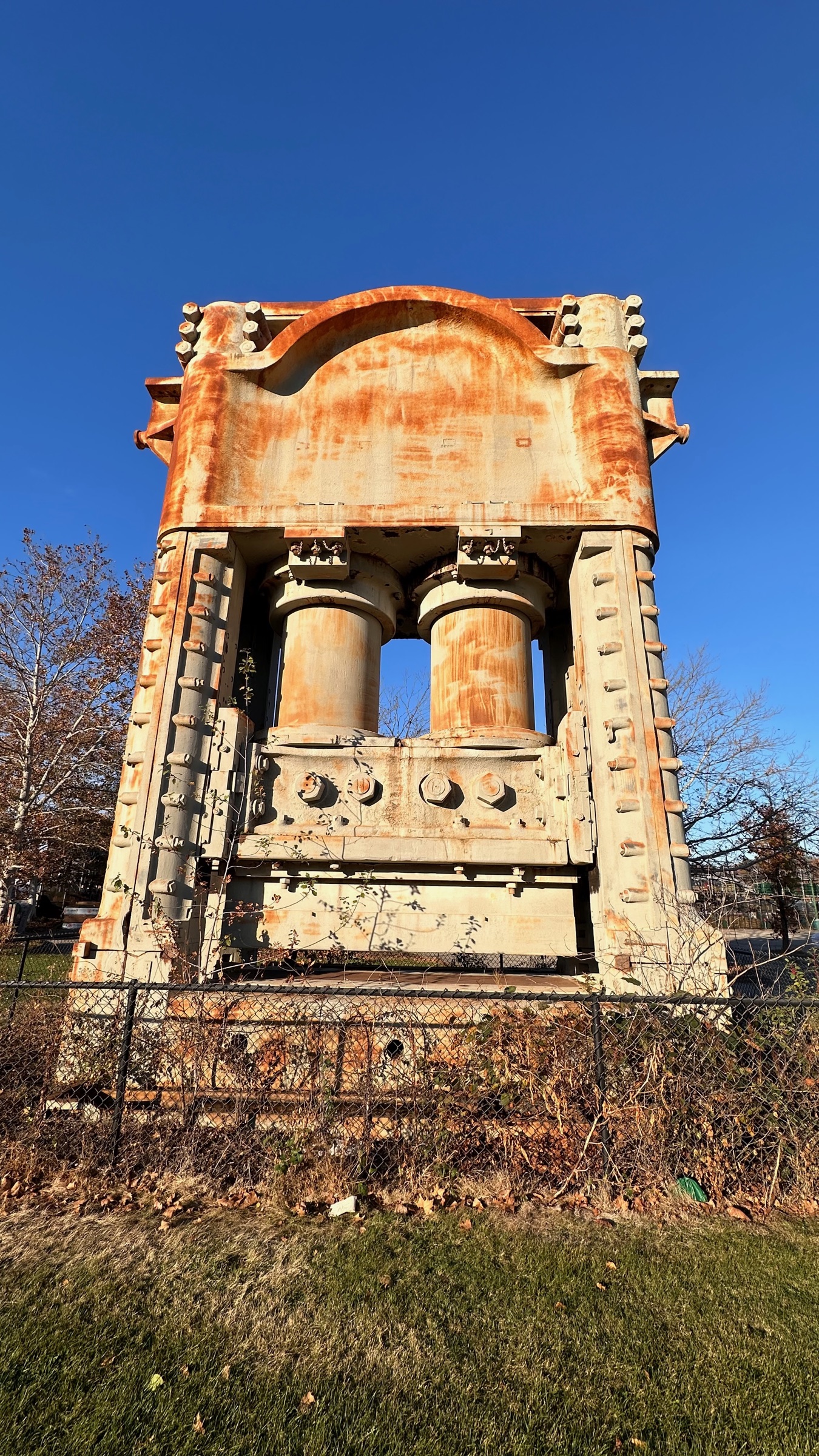
That any of them survives is something of an accident. When the mill site was redeveloped in the late 1990s, Lowe’s wanted the press removed to make room for parking. Moving it would have cost about half a million dollars and risked buckling the roads it had to cross, so the store was built around it instead. It is a fitting final stop: the Altoona shops built the locomotives, and presses like this one made the steel that armored the fleet.19
Homestead and Its Steel Works
The press is one of the few surviving pieces of what was, for many years, the largest steel mill in the world. The Homestead Works opened along the Monongahela in 1881, built by a group of local industrialists, and Andrew Carnegie bought it two years later and made it the heart of Carnegie Steel. When J. P. Morgan merged Carnegie Steel into U.S. Steel in 1901, Homestead became that company’s flagship. At its height the works covered some 430 acres on both banks of the river and employed well over 12,000 people, by some counts 15,000. Besides armor for the Navy, it rolled structural steel for American skylines; the Rivers of Steel markers count the Empire State Building, the Sears Tower, and the Gateway Arch among the landmarks built with Homestead steel.
Homestead’s name is also bound up with one of the most violent labor disputes in American history, the Battle of Homestead in 1892, told below at the Pump House where it was fought.
The decline came in stages. U.S. Steel shut the works down piece by piece from 1979, and the last steel was made in 1986. The buildings were demolished in the early 1990s, and The Waterfront shopping center opened on the site in 1999. The town followed the mill: Homestead had more than 20,000 residents in 1920 and about 3,200 by 2010. A few fragments remain. A row of the mill’s smokestacks still stands among the stores, the press waits behind the Lowe’s, and across the river the Carrie Furnaces, two blast furnaces that fed iron to the works until 1978, survive as a National Historic Landmark open for tours.20
The Homestead Labyrinth
The walk from the press to the Pump House passes right beside something I had not known was there: the Homestead Labyrinth, set in a quiet pocket of the Monongahela riverbank and screened from Waterfront Drive by a small rise. It is worth stopping and taking the time to walk it.
A labyrinth is not a maze. A maze is a puzzle of branching paths and dead ends; a labyrinth has a single path that winds back and forth, but never forks, from the entrance to the center and back again. There is nothing to solve and no way to get lost, which is the point. The form is ancient, and in the Middle Ages labyrinths were laid into the floors of cathedrals, the best known at Chartres, where walking the path served as a meditation or a symbolic pilgrimage.
This one was made in 2009 by the artist Lorraine Vullo and is maintained by Rivers of Steel. It is 68 feet across, built of hand-cut cobblestone, engraved concrete, earth, and grass, with a six-pointed star at its center. Vullo conceived it partly as a memorial to those killed in the Battle of Homestead on these same grounds in 1892. Around its outer circle runs a border of concrete triangles engraved with the names of about 120 regional historic steel facilities, chosen with the help of Rivers of Steel’s archivist; one triangle she reserved for her late father. Walking it slowly, a few hundred yards from where the Pinkertons came ashore is a more fitting way to remember that day than any plaque.21
For geocachers, there is a bonus. While in the area I found the Homestead Labyrinth geocache, GCA7JPE, which reaffirmed my Pennsylvania state geocache award.
The Pump House and the Battle of Homestead
A few steps from the labyrinth stands the Pump House, a brick building on the riverbank that is the most important surviving landmark of the Battle of Homestead. Rivers of Steel, which owns it, opens it for tours and programs only from April through October, so in November I could see it only from the outside. Visitors who want to go in should plan accordingly.
Its information board gives its pumping capacity near 18 thousand gallons a minute, river water drawn from the Monongahela for the mill. Running around the clock, that is about 25.5 million gallons a day, and the comparison with today’s argument over data centers is striking. An average data center uses roughly 300 thousand gallons a day, so this one pumping station moved as much water as some 85 of them; it equals about five of the very largest hyperscale sites, nearly the entire daily consumption of Google’s worldwide data-center fleet in 2025, and about half the direct water use of every data center in the United States. The mill withdrew river water and returned most of it, warmer and dirtier, to the river, whereas a data center’s evaporative cooling consumes its water, turning it to vapor, and often draws it from a town’s drinking supply. A gallon consumed weighs more heavily in a community than a gallon borrowed, which is why the modern controversy is less about the totals than about where the water comes from and whether it comes back. The board’s figure is also most likely the pumps’ rated capacity rather than what they delivered day in and day out.22
The battle itself is the reason the building is preserved. By 1892 the Amalgamated Association of Iron and Steel Workers, then the strongest craft union in the country, held a contract at Homestead that was due to expire at the end of June. Andrew Carnegie, away in Scotland, left his partner Henry Clay Frick free to break the union. Frick demanded steep wage cuts, ringed the works with a high fence topped with barbed wire, which the workers promptly named “Fort Frick,” and when the union refused his terms, locked out the entire workforce of about 3,800. The town closed ranks behind the strikers, who posted pickets along the river and the roads.
Frick’s answer was the Pinkerton National Detective Agency. Before dawn on July 6, about 300 Pinkerton agents, armed with Winchester rifles, were towed up the Monongahela in two covered barges behind the tug Little Bill, intending to land at the mill and take it back. They were spotted, and by the time the barges reached the landing here, thousands of strikers and townspeople were waiting on the bank. Who fired first has never been settled. The shooting went on, with pauses, for some twelve hours; the strikers turned a small cannon on the barges and tried to set them afire. In the afternoon the trapped Pinkertons surrendered and were marched up through a gauntlet of furious townspeople who beat many of them. At least three Pinkertons and seven workers were killed; some accounts give higher figures.
The workers’ victory lasted less than a week. On July 12 the governor sent in the Pennsylvania National Guard, some 8,000 strong; under its protection Frick brought in strikebreakers and restarted the mill. Public sympathy for the strikers, already strained by the treatment of the surrendered Pinkertons, collapsed after July 23, when the anarchist Alexander Berkman, who had no connection to the union, shot and stabbed Frick in his Pittsburgh office. Frick survived. Strike leaders were charged with murder and even treason, and although most were acquitted, the legal battles drained the union. The strike formally ended on November 20, 1892, in complete defeat. The union was broken at Homestead, wages were cut, and the American steel industry remained largely non-union for the next four decades, until the steelworkers organized in the 1930s.23
Tocqueville’s Warning, Then and Now
Standing where the Pinkertons landed, it is hard not to think of the chapter in Democracy in America titled “How an Aristocracy May Be Created by Manufactures.” Tocqueville argued that the division of labor would make the worker ever narrower and more dependent, while the owner grew ever more removed from him, until the two belonged to different worlds. He called the manufacturing aristocracy rising in his time “one of the harshest whichever existed in the world.” In fairness to him, he added in the same breath that it was also one of the most confined and least dangerous, because its members were scattered, changed constantly, and felt no common purpose as a class. Homestead tested both halves of that judgment. Frick and Carnegie behaved exactly like the hard masters he foresaw. Yet the fortune they built did not become a hereditary caste: Carnegie gave most of his money away, and within half a century the unions, the income tax, and the New Deal had narrowed the gap.
The question I kept returning to on the riverbank is whether Tocqueville’s reassurance still holds. By some measures, today’s greatest fortunes now exceed those of Homestead’s heyday. Estimates of the largest Gilded Age fortunes, Carnegie’s and Rockefeller’s, generally put them at around one to two percent of the American economy at their peaks. As of November 1, 2026, Forbes estimated Elon Musk’s net worth at about $869 billion, close to three percent of a roughly $30 trillion American economy, and in October 2025 he became the first person ever worth $500 billion. Economists Emmanuel Saez and Gabriel Zucman estimate that the few dozen richest American households now hold a share of national wealth several times larger than their counterparts did around 1910, and Paul Krugman has called the present a “hyper-gilded age.”
The picture is not uniform. Measured across the broader top tenth of one percent, wealth concentration has climbed to the highest level since the Federal Reserve began tracking it in 1989, but by Saez and Zucman’s reconstruction it remains below the peaks of 1916 and 1929. Other economists, notably Gerald Auten and David Splinter, argue that standard estimates overstate how much inequality has grown, and the measurements remain disputed. It’s not disputed that a handful of individuals now command fortunes larger, relative to the nation, than anything Carnegie or Frick possessed. To my mind, that makes Tocqueville’s warning more pertinent now than it was when the Pinkertons came up the river, and his reassurance that such an aristocracy would stay confined and harmless a good deal less certain.24
On the short walk from the labyrinth to the Pump House, the path passes under a railroad bridge, and on one of its concrete columns is spray-painted three words: “Arm the left.” I do not know who wrote it, though the paint looked very fresh, and graffiti is not a poll. But it was a jarring thing to come upon a few hundred yards from where armed strikers and armed Pinkertons fired on one another in 1892, and just beyond a labyrinth built to remember the dead. The grievances that brought rifles to this riverbank were supposed to have been settled long ago by unions, laws, and the ballot. At least a few no longer believe they have been, and that is a measure of how far the country has drifted from the confidence Tocqueville recorded. I confess I was not surprised to see it. Given the extremes of wealth described above and the mood of the country, it seems to me that we may be nearing another flash point.
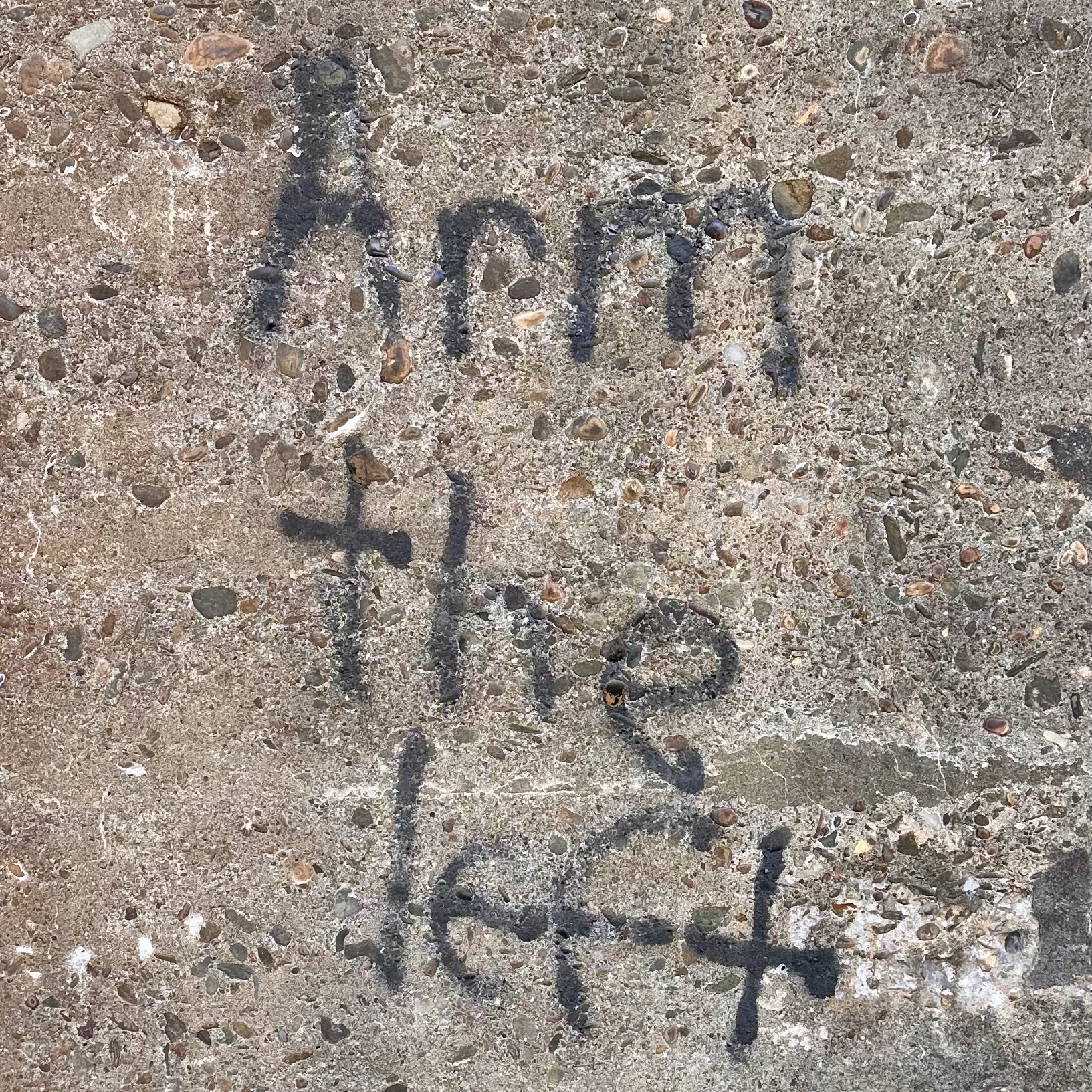
Standing on the quiet riverbank, with the shopping center behind the rise, it takes some imagination to picture the barges, the crowds on the bank, and a day’s gunfire. The Pump House, the labyrinth, and the Bost Building in town, the strikers’ headquarters and now a National Historic Landmark, are what remain to help.
For the next visitor
- The 12,000-ton press: 690 East Waterfront Drive, Homestead, the address of the Rivers of Steel marker beside it. It is easy to miss; look behind the Lowe’s at the east end of The Waterfront. Outdoors and free; 30 to 45 minutes is enough, and it makes an easy stop on the way to the airport.
- Walking from the press to the Pump House: Do not try to cut across the open field between them. It is posted extensively with No Trespassing signs, several of them warning that the area is patrolled by security. Stay on the streets and sidewalks of The Waterfront, or take a short Uber.
- The Homestead Labyrinth: beside the Pump House along the river, on the way from the press. Free and always open; allow 15 to 20 minutes to walk it slowly. Look for the engraved names of the region’s steel facilities on the border stones. Geocachers: the Homestead Labyrinth cache, GCA7JPE, is nearby.
- The Pump House: Rivers of Steel opens it for tours and programs only from April through October. Out of season you can see it only from outside, so plan a warm-weather visit if you want to go in, and check https://riversofsteel.com for tour times.
Side Notes: Pittsburgh Curiosities
The Pittsburgh Potty
Many older Pittsburgh houses have a feature locals call the “Pittsburgh potty”: a lone toilet standing in the open basement, with no walls, no door, and often no sink. They tend to appear in houses built between roughly 1880 and 1910, and they fell out of fashion after the Second World War.
The popular explanation is that steelworkers came home through the basement, washed off the mill grime, and used the toilet there before going upstairs to dinner. Plumbing historians offer a less romantic account. Early sewer systems were unreliable, and a backup floods the lowest fixture in the house, so a basement toilet served as a sacrificial overflow point that kept sewage out of the living quarters. Whatever the origin, most owners leave them in place, since removing one is not free, and many regard theirs with real affection.25
Funeral Homes and the Single-Lid Casket
Pittsburgh funeral homes have a custom that surprises visitors. Caskets here typically use a single full-length lid, called a “full couch” casket, which opens to show the whole body at the viewing. Elsewhere in the country the norm is the split “half-couch” lid, which opens only over the upper body. I was told this locally; published sources confirm that full-couch caskets are a common choice in Pennsylvania, though I could not find a documented explanation for the regional preference.
The more striking thing is how many funeral homes there are. Pittsburgh was built by waves of immigrants who settled in ethnic enclaves near the mills along the rivers: Polish, Slovak, Italian, Irish, German, Croatian, Jewish, and African American communities, among others. Each neighborhood built its own church, and each wanted its own funeral director, someone who shared its language, faith, and customs. The city’s hills and rivers kept those neighborhoods physically apart, which reinforced the pattern. Segregation added its own layer: in the Hill District, the West Funeral Home was for many years one of the few funeral homes African Americans could use.
The result is a remarkable surplus. In 2017 the president of the Funeral Consumers Alliance counted about 200 funeral homes in the city of Pittsburgh alone, an overstock he attributed to segmentation by ethnicity and race. Pennsylvania as a whole had roughly three times the number of funeral homes its death rate would justify. Driving through the city’s neighborhoods, you notice them everywhere, often in large old houses on the main street, each one a marker of the community that built it.26
Because so many of these homes are small, family-owned neighborhood businesses, I was told that Pittsburgh funeral directors tend to do nearly every job themselves: meeting the family, embalming and preparing the body, running the viewing, and often driving the hearse. Elsewhere, larger operations divide that work among specialized staff or outside services.
Isaly’s Chipped Ham
Another local food recommendation is Isaly’s chipped ham, a Pittsburgh staple. Chipped chopped ham is ordinary chopped ham shaved razor-thin on a slicer, which softens the texture and brings out the flavor. Locally, the cut is called “Pittsburgh style.” It is often heated in barbecue sauce for a “ham barbecue” sandwich.
Isaly’s was a dairy-store chain with hundreds of shops across the tri-state area. It began serving chopped ham sliced this way in the late 1930s, and ham sales soon outpaced its ice cream. The same company created the Skyscraper ice cream cone and the Klondike bar. The stores are gone, but Isaly’s chipped ham and barbecue sauce are still sold under the Isaly’s name, and chipped ham is available at most Pittsburgh-area deli counters.27
From Pittsburgh to the iPhone: The PERQ, Accent, and Mach
During the museum tour, Mark sketched out a thread of computing history that runs from Pittsburgh to the phone in my pocket. I looked into it further, and the connections hold up.
The PERQ (1979). In 1974 a group of six Carnegie Mellon alumni and staff, among them Brian Rosen and Raj Reddy, founded Three Rivers Computer Corporation, named for the city’s three rivers. Their machine, the PERQ, was strongly influenced by the Xerox Alto (Rosen had worked at Xerox PARC). A prototype was shown at SIGGRAPH in 1979, and it is generally credited as the first commercially produced personal workstation with a graphical user interface. The name was meant to evoke a workplace “perk” and to stand for “Pascal Engine that Runs Quicker.” Its microcoded instruction set, called Q-Code, was designed to run Pascal directly, at up to a million instructions per second, which gave rise to the alternative reading I heard on the tour: “Pascal Evaluation Real Quick.” The company was renamed PERQ Systems in 1984 and closed in 1986, overtaken by Sun, Apollo, and Silicon Graphics.
Accent (1981). Meanwhile, Carnegie Mellon’s Spice project (Scientific Personal Integrated Computing Environment) set out to build a network of personal scientific workstations, and it chose the PERQ as its machine. Richard Rashid and George Robertson designed a new operating system kernel for it, called Accent, built around message passing: programs and the kernel communicated by sending messages through “ports.” At its peak, Accent ran a network of about 150 PERQs at CMU.
Mach (1985). By the mid-1980s the industry was moving to Unix and to multiprocessor machines, so CMU ended work on Accent and started over. The new kernel, Mach, carried Accent’s ports and messaging design into a Unix-compatible system. It was led by Rashid and a graduate student named Avie Tevanian. Mach became one of the most influential operating systems of its era; Rashid and Tevanian received the ACM Software System Award for it in 2014.
NeXT (1988). Tevanian left CMU to join Steve Jobs’s new company, NeXT, where he built the NeXTSTEP operating system on his Mach work, combining Mach with BSD Unix. It shipped on the NeXT Cube in 1988.
Apple (1997 onward). When Apple acquired NeXT in 1997, it gained both NeXTSTEP and Tevanian, who became Apple’s head of software. NeXTSTEP was reworked into Mac OS X, whose kernel, XNU, is a hybrid of Mach and BSD. iOS was built on the same foundation, and iPadOS, watchOS, and tvOS all derive from iOS.
So the line runs from a workstation company named for Pittsburgh’s rivers, through a CMU kernel written for that workstation, to Mach, to NeXT, and into every Mac, iPhone, iPad, Apple Watch, and Apple TV in use today.28 Ideas from a 1981 operating system for the PERQ still sit at the heart of the iPhone kernel. It is one more example of how much modern technology traces back to Pittsburgh and Carnegie Mellon, and a fine reason to visit a museum that still keeps these machines running.
For a Future Visit
- Millvale is a small river borough on the Allegheny, just across the 40th Street Bridge from Lawrenceville and only a few minutes from downtown. It came up repeatedly in conversation, and I would make time for it next trip. Its main street, Grant Avenue, holds two stops within a few doors of each other, and there is a remarkable church on the hill above.
- Curated Flame, 505 Grant Ave. A local social-media personality’s shop, run by its owner, Mo. It is a smoke shop, but its draw for visitors is the curation: vintage lighters, handblown glass, quirky collectibles, and its popular gumball and vending machines that dispense surprise prizes at various price points. Open Monday through Saturday 11 AM–8 PM, Sun 11 AM–7 PM; (412) 230-6097; curatedflamepgh.com.
- The Attic Records, 513 Grant Ave. A large record shop of nooks and crannies with a mix of new and used vinyl, a natural companion to Jerry’s. It can get very crowded on weekends.
- The Maxo Vanka murals, St. Nicholas Croatian Catholic Church, 24 Maryland Ave. The church was part of the first ethnic Croatian parish in the United States. In 1937 and 1941 the Croatian immigrant artist Maxo Vanka covered its interior with 25 murals depicting the lives of the working-class immigrant congregation, along with pointed anti-war and social commentary. They fit the same story as the city’s ethnic churches and funeral homes. Viewing is by guided tour (about an hour), booked through https://vankamurals.org.29
- Alto Model Train Museum Association, 1117 9th Avenue, Altoona, almost across the street from the Railroaders Memorial Museum. A model railroad club with layouts in several scales spread across multiple rooms. It has been open to visitors on limited days, reportedly the third full weekend of each month, so check before going and plan a Railroaders Museum visit around it.
- ALTO Tower, Altoona. A surviving Pennsylvania Railroad interlocking tower, once one of the control points for the busy Altoona main line. Worth seeking out for anyone interested in how the railroad was run. Check locally for access.
- Railroaders Memorial Museum roundhouse tours. If you can visit on a Saturday, the museum offers behind-the-scenes guided tours of its roundhouse, included with admission.
- The Duquesne Incline, the 1877 cable car up Mount Washington, best ridden at night for the skyline view over the Point and the three rivers. It was on my list every evening of this trip, but after full days I was never motivated to make the trip across the river. It runs 6:30 AM to 12:30 AM daily, and the lower station is a short Uber ride from the Point.30
- The Carrie Blast Furnaces, 801 Carrie Furnace Blvd., across the Monongahela from Homestead in Rankin and Swissvale. Furnaces No. 6 and 7, built by Carnegie Steel around 1907, made the iron for the Homestead Works until the late 1970s, and are the only pre-war blast furnaces in the region to escape demolition. Now a National Historic Landmark run by Rivers of Steel, they are the natural companion to the press and the Pump House: the one place where you can still stand inside the machinery of the steel industry rather than beside a fragment of it. Guided tours, often led by former steelworkers, run roughly May through October and take about 1.5 to 2 hours; Rivers of Steel also offers graffiti-art tours and iron-casting workshops on the site. Book ahead and check current access, since the site is undergoing a multiyear restoration.31
Getting Around Without a Car
The trip worked well without a car, with a little planning.
- Within Pittsburgh: Uber and Lyft are convenient to get downtown and in the nearby neighborhoods, and downtown itself is walkable. I walked to Union Station before dawn and from the Warhol back across the river to Primanti Bros. without difficulty.
- Outlying towns: Places such as New Kensington are much easier to reach than to leave. Pre-book the return ride before you go or arrange for your driver to come back for you.
- Altoona by rail: Amtrak’s Pennsylvanian makes a comfortable day trip, leaving Pittsburgh at 7:30 AM and returning at about 8:05 PM32, with the Horseshoe Curve in both directions. On a sold-out train, the Business Class car was sparsely occupied and comfortable.
- A car for the day: The Curve, Gallitzin, and the Portage Railroad are spread across rural roads with little rideshare service, so a one-day rental is the practical answer. Enterprise on Aldrich Avenue picked me up at the station and took me back.
- Homestead and the airport: The Waterfront is about 20 minutes from downtown by Uber, and it is an easy stop on the way to the airport with luggage.
Reflections
Tocqueville came to Pittsburgh when it was a smoky river town at the edge of the West and left convinced that he had seen the future. The places I visited over these five days are, in a sense, the future he foresaw, built, and then spent. The Pennsylvania Railroad conquered the mountains he crossed by stagecoach, built its own locomotives by the thousand, and ran a testing plant that made Altoona a capital of engineering; today its shops are largely gone, its main line carries ever-longer freight trains that derail on the Curve, and its finest surviving locomotive waits in a roped-off roundhouse on small donations. The Homestead Works rolled the steel for skyscrapers and armored a navy; today its last great press stands in a patch of grass behind a Lowe’s. New Kensington was the city Alcoa built until Alcoa left. And the passenger, who once arrived in a Burnham palace, now waits in an annex behind it.
It is hard not to read all of this as decline, and I do. A nation that once could not stop building now struggles to maintain what it built, and it treats the history of its own achievement as something for volunteers and gift shops to look after. If Tocqueville’s America was a nation in its ascendancy, the America I traveled through this week too often feels like one living on its inheritance.
Yet Tocqueville would have recognized some of what I saw. He thought the genius of Americans lay less in their government than in their habit of joining together to do what needed doing, and that habit is still visible. A volunteer gave up an afternoon to boot decades-old computers for a stranger. Volunteers trained in the old Juniata shops are restoring a 1918 steam locomotive. A nonprofit is building a new T1 from nothing in an Ohio railroad depot. An Uber driver has made it his business to help his town recover, one passenger and one sandwich at a time. Pittsburgh itself reinvented a computing industry out of Carnegie Mellon, and ideas first written for a Pittsburgh workstation still sit at the heart of the phone in my pocket. The machinery of the ascendancy has rusted; the people Tocqueville admired have not entirely disappeared.
I would go back, for the Duquesne Incline I never rode, Millvale and its murals, the Pump House in season, and another visit to the Large Scale Systems Museum, and perhaps, as Tocqueville did, by way of the river.
Useful Contacts and Links
| Place | Contact | Address |
|---|---|---|
| Large Scale Systems Museum | info@lssmuseum.org (visits by appointment) | 924 4th Ave, New Kensington, PA 15068 |
| Jerry’s Records | Cash preferred | 2136 Murray Ave, Pittsburgh (Squirrel Hill) |
| Wyndham Grand Pittsburgh Downtown | Burn After Meeting conference hotel | 600 Commonwealth Place, Pittsburgh |
| Amtrak | 1-800-872-7245 | Union Station, 1100 Liberty Ave, Pittsburgh |
| Enterprise Altoona | (814) 942-7000 | 412 Aldrich Ave, Altoona, PA 16602 |
| Horseshoe Curve NHL | (814) 946-0834 ext. 2101 | 2400 Veterans Memorial Hwy, Altoona, PA 16601 |
| Railroaders Memorial Museum | (814) 946-0834 ext. 2102 | 1200 9th Ave, Altoona, PA 16602 |
| Allegheny Portage Railroad NHS | (814) 886-6150 | 110 Federal Park Rd, Gallitzin, PA 16641 |
| Andy Warhol Museum | (412) 237-8300 | 117 Sandusky St, Pittsburgh (North Shore) |
| 12,000-ton press | Rivers of Steel marker | 690 East Waterfront Dr, Homestead, PA 15120 |
| Pump House and Homestead Labyrinth | Rivers of Steel (Pump House tours April–October) | East Waterfront Dr, Munhall, PA |
Sources for the facts in this travelogue are collected in the notes below.
A Note on How This Was Written
The observations, experiences, and opinions in this travelogue are my own, sent as notes from the road over the five days of the trip. I worked with Claude, an AI language model made by Anthropic, to edit and compose the text, to research and verify the historical and background material, and to plan and maintain the trip itinerary. Facts drawn from outside sources are listed in the notes at the end; any errors of judgment are mine.
I am aware of the irony that my travelogue that frets over data centers evaporating water while the new aristocracy pulls ever further ahead. Yet it was itself composed with the help of an AI running in an unknown data center that boiled off cooling water and added a few more cents to the fortunes of the neo-aristocracy along the way. The Homestead Pump House, at least, gave its water back to the river.
Notes and References
The notes below list the sources consulted for each part of this travelogue. Quotations from Democracy in America are from the public-domain Henry Reeve translation.
Tocqueville’s travels. ERIC: Tocqueville and Beaumont’s itinerary (PDF); Tocqueville Association: The American adventure; Hudson Review: Tocqueville’s Letters from America; James Vermillion: On the Road with Tocqueville; Yale Beinecke: Beaumont’s sketchbook.↩︎
The Fort Pitt Tunnel. Wikipedia, Fort Pitt Tunnel; Historic Pittsburgh: Fort Pitt Tunnel under construction.↩︎
Valuing the vinyl haul. Shuga Records: Ram, 1971 Apple USA; eBay: Ram 1971 US sale; Aqualung first-pressing listings; GripSweat: sealed Boston, 1976 sale; 45 worlds: Boston PE/JE 34188; ValueYourMusic: Dark Side complete early US; 45worlds: Dark Side SMAS-11163; Damn the Torpedoes MCA-1486 release data; eBay: The Cars 6E-135 first-press sale.↩︎
New Kensington. Penn State: Lean Economic Development mini-case, New Kensington; WESA: Rebuilding New Kensington, the city Alcoa made; TribLive: Schreiber Industrial Park history; TribLive: New Kensington and Arnold; MSU dissertation: Birthplace of Aluminum, Cradle of Crime.↩︎
The Large Scale Systems Museum collection. Wikipedia, Richard Greenblatt; Wikipedia, Intel iPSC; technikum29: IBM 5320 System/32 spec sheet; Heathkit EC-1 overview; Space Cadet keyboard history; Wikipedia, Parsytec; Museums Victoria: Lisa Twiggy disks.↩︎
The Tektronix 4081 and Battlestar Galactica. Tekniques vol. 2 no. 7 (1978); TekWiki: 4081; classiccmp: Tektronix 4081 recollections; VCF forum: Battlestar Galactica demo for Tektronix 4050; Vintage Tek: Tektronix in movies and shows.↩︎
Jerry’s Records. Pitt News: Pittsburgh’s best record stores.↩︎
Pittsburgh dining and evenings. Primanti Bros.: locations; Downtown Pittsburgh: Eddie V’s opening; ConcertHotels: Eddie V’s Pittsburgh hours; Pittsburgh Orbit: Beto’s of Beechview; Discover the Burgh: Beto’s Pizza review; Omni William Penn: The Speakeasy; TableJourney: Acacia.↩︎
Union Station. Wikipedia, Union Station (Pittsburgh); Historic Pittsburgh: Pennsylvania Station; Remitly: Pittsburgh Amtrak Station guide.↩︎
Altoona and the Pennsylvania Railroad shops. NPS: Pennsylvania Railroad Shops and Works, Altoona.↩︎
The Horseshoe Curve and the Railroaders Memorial Museum. Railroaders Memorial Museum: Admission; Railroaders Memorial Museum: Horseshoe Curve; Railroaders Memorial Museum: Sites; Altoona Mirror: Horseshoe Curve funicular back on track (June 2026); Altoona Mirror: Curve funicular back up and running (Nov 2024); Trains: Horseshoe Curve funicular reopens after $150,000 overhaul; Wikipedia, Railroaders Memorial Museum.↩︎
Derailments and long trains at the Curve. WPSU: Third derailment this year near the Curve (Aug 2026); Trains: NS train derails near Horseshoe Curve (Feb 2026); WJAC: Two locomotives, 17 railcars derail (Mar 2026); Trains: NS tightens train makeup standards.↩︎
The K4s No. 1361 restoration. Wikipedia, Pennsylvania Railroad 1361; American-Rails: K4s No. 1361 funding (July 23, 2026); Trains: K4s 1361 restoration moves past halfway point; Trains: K4s 1361 to be restored in $2.6 million campaign; Trains: T1 Trust shows frame and drivers; K4s 1361 tender painted; WTAJ: Altoona benefit dinner for K4 restoration; Railroaders Memorial Museum: Rolling stock.↩︎
GG1 No. 4913. RailPictures.net: PRR 4913 at Altoona.↩︎
Norfolk Southern’s support for the museum. Altoona Mirror: Norfolk Southern donates to fire companies and the museum (Aug 2025); Trains: Altoona museum gets SD60I; Progressive Railroading: NS donates $50,000 for scholarships.↩︎
The new T1, No. 5550. Wikipedia, Pennsylvania Railroad 5550.↩︎
Julia Warhola. The Warhol: Admission and Hours; The Warhol: Admission and Hours; The Warhol: Julia Warhola; Wikipedia, Julia Warhola; TheCollector: Who Was Julia Warhola?; Hyperallergic: Julia Warhola Was an Artist in Her Own Right; Revolver Gallery: Julia Warhola; UCCA audio guide: Andy Warhol; TheCollector: Who Was Julia Warhola?; Art Gallery NSW: Julia, Warhol’s mother; Airmail: A Boy’s Best Friend; Hyperallergic: Julia Warhola Was an Artist in Her Own Right; Revolver Gallery: Julia Warhola; University of Pittsburgh Press: Andy Warhol’s Mother (Rusinko).↩︎
Warhol and Dolly Parton. The Art Newspaper: When Dolly met Andy (Aug 26, 2026); AI-AP: Smithsonian and Warhol Museum honor Dolly Parton; Business Insider: Parton at Studio 54 with Warhol; Cheat Sheet: “weirder than me”; AnOther: Warhol’s Polaroids of pop culture icons.↩︎
The 12,000-ton press. HMdb: “Armor for America” marker; Library of Congress / HAER: 12,000 Ton Press, Bethlehem Steel, 1903; Library of Congress / HAER PA-200: Homestead Works; Pittsburgh City Paper: 25 years of The Waterfront; Practical Machinist: hydraulic pump for the 12,000-ton press; Towns and Nature: Homestead Works detail photos; Getty Images: the press in 2008.↩︎
The Homestead Works. Clio: Carrie Furnaces and the Homestead Works; CLUI: Homestead Steel Works site; HMdb: Homestead Works marker; Britannica: Homestead, Pennsylvania; Homestead Hebrews: Living in America’s leading steel town; eofp.net: Homestead; Wikipedia (mirror): Homestead, Pennsylvania; Wikiwand: Homestead Steel Works.↩︎
The Homestead Labyrinth. The Waterfront: Historical landmarks; The Waterfront: Historical walking map (PDF); Pittsburgh City Paper: An artist’s labyrinth as industrial memorial; Pittsburgh City Paper: Hidden-gem green spaces; Pittsburgh Murals: Homestead Labyrinth.↩︎
Pump House water and data centers. Pump House information board (seen on site); UGA Field Report: Data centers and water; GreenCalculus: Data center water usage; DatacenterDynamics: Google’s 2025 environmental figures; HPCwire: Is AI really going to drink us dry?; UC: Data center water spikes could cost billions.↩︎
The Battle of Homestead. Britannica: Homestead Strike; JSTOR Daily: how steelworkers stopped a paramilitary movement; Battle of Homestead Foundation; AFL-CIO Kentucky: Homestead, they fought for home; Zinn Education Project: Homestead Strike; Lawyers, Guns & Money: July 6, 1892; HistorySpeak: Homestead Strike (PDF); American Heritage: “Works are not worth one drop of human blood”.↩︎
Gilded Age fortunes and today’s. Forbes Australia: Top 10 richest people (November 2026); Forbes Australia: Top 10 richest (Nov 2026), Musk history; FatFIRE: Rockefeller’s wealth adjusted for inflation; BBC History Magazine: Three titans of big business; Fortune: Carnegie, the Giving Pledge, and inequality (July 2026); Crypto Briefing: Saez and Zucman on the top 0.00001%; Traders Union: Wealth concentration nears Gilded Age levels; Stone Center (CUNY): Krugman on oligarchs and mega-fortunes; Inequality.org: Auten-Splinter debate; Independent Institute: Outliers vs. Consensus (PDF).↩︎
The Pittsburgh potty. TODAY: What is a Pittsburgh potty?; WESA: Documenting the Pittsburgh potty; Brookline Connection: History of the Pittsburgh Potty.↩︎
Pittsburgh’s funeral homes. Casket Emporium: Full-couch caskets in Pennsylvania; Post-Gazette: African-American funeral homes face their own challenges (2017); Clio: West Funeral Home; PublicSource: Pittsburgh’s immigrant enclaves and houses of worship.↩︎
Isaly’s chipped ham. Wikipedia, Chipped chopped ham; Heinz History Center: Isaly’s book; Erie County Historical Society: Isaly’s.↩︎
From the PERQ to the iPhone. Wikipedia, PERQ; Wikipedia, Accent kernel; Rashid & Robertson, “Accent” (SOSP 1981); Computer History Museum: Avie Tevanian; ACM Software System Award: Mach; Computer History Museum: Avie Tevanian; Wikipedia, Avie Tevanian.↩︎
Millvale. Curated Flame: Contact; Antique Stores Nearby: Curated Flame; Axios Pittsburgh: Best record stores (Feb 2026); Atlas Obscura: Murals of Maxo Vanka; Vanka Murals: Public tours.↩︎
The Duquesne Incline. Pittsburgh Regional Transit: Riding the Inclines; Kid City Guide: Duquesne Incline.↩︎
The Carrie Blast Furnaces. Rivers of Steel: graffiti tours at the Carrie Blast Furnaces; Rivers of Steel: RAD Day at the Carrie Blast Furnaces; Uncovering PA: Carrie Blast Furnace; TribLive: Staycation destination, Carrie Blast Furnaces; Morgantown Magazine: Beauty in the burn.↩︎
Amtrak’s Pennsylvanian. Amtrak Pennsylvanian timetable; Amtrak: second Pennsylvanian begins Nov. 18; SpotATrain: Horseshoe Curve.↩︎